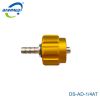
A common assumption in medical gas system procurement is that if the outlet complies with ISO 9170-1 and the adaptor or connector complies with the relevant connector standard, the two should fit. Standards do a great deal of work: they define gas-specific indexing, dimensional envelopes, and performance requirements so that products from different sources are, in principle, interchangeable within the same connection style. But a standard-compliant part is not a perfectly dimensioned part. Every permitted dimension carries a tolerance band. When the outlet and the mating adaptor come from different manufacturers, those two tolerance bands can work against each other — and in the worst case, the connection either does not latch reliably or does not fit at all.
This is the practical argument for purchasing medical gas outlets and their matching adaptors or connectors from the same manufacturer: not because standards are inadequate, but because a single manufacturer controls both sides of the tolerance equation.
ISO 9170-1 governs terminal units for medical gas pipeline systems. It sets requirements for gas specificity, retention, check valves, maintenance valves, and endurance of the connection/release cycle. For the connector side, ISO 5359 specifies the allocation and dimensions of non-interchangeable screw-threaded (NIST) connectors, diameter-index safety system (DISS) connectors, and sleeve indexed system (SIS) connectors. NFPA 99 adds installation and performance requirements, and requires gas-specific pin indexing and latch mechanisms that accept only corresponding adaptors.
These standards are essential safety instruments. They prevent oxygen from being connected to a nitrous oxide outlet, and they ensure that a probe or adaptor intended for one gas service cannot be inserted into a terminal unit for another. The historical problem that different manufacturers used entirely incompatible keying structures — so that one maker's adaptor simply would not enter another maker's outlet — is precisely the kind of hazard that standards were designed to reduce.
However, dimensional standardisation within a connection style is not the same as zero interface variation. When ISO 5359 or an equivalent national standard specifies a dimension, it specifies that dimension with a tolerance. The standard tells a manufacturer that the dimension must fall inside a permitted range; it does not tell every manufacturer to aim for the exact same point inside that range.
Consider a simplified but representative scenario. An outlet's critical mating feature is permitted to range from, say, a nominal dimension to slightly above nominal — an upper-tolerance bias. An adaptor's corresponding feature is permitted to range from nominal down to slightly below nominal — a lower-tolerance bias. Each part individually passes inspection. Each is “standard-compliant.” Yet when they meet, the clearance or interference between them is the sum of both deviations in the worst direction. This is tolerance stack-up at the interface.